
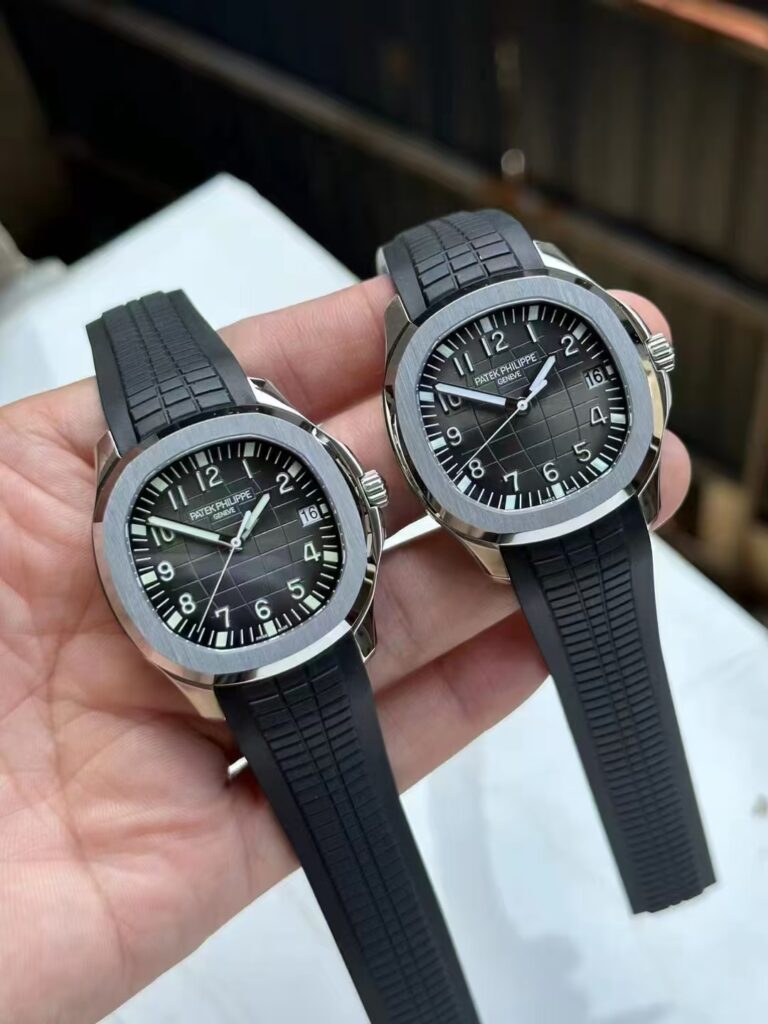
The Patek Philippe Aquanaut 5167 looks simple until its proportions are compared closely. The rounded-octagonal bezel, thin steel case, embossed dial and integrated composite strap have to work as one shape. That makes the model a useful test for replica finishing. The old version of this article buried those points under factory rankings, “ultimate guide” language and instructions about where to buy. This revision focuses on the watch itself.
The genuine 5167A gives clear proportions to work from
Patek Philippe lists the steel Aquanaut 5167A at 40.8 mm across the case from 10 to 4 o’clock and 8.1 mm thick. The current reference uses calibre 26-330 S C, with a date aperture and sweep seconds, and is paired with a composite strap. Those genuine figures are useful because case thickness is one of the easiest areas for a replica to lose the Aquanaut’s character.
A replica that is noticeably thicker can still look acceptable from the front, but the side view tells a different story. Bezel height, case-back depth and crown size all influence whether the watch retains the flat, compact profile associated with the 5167.
The embossed dial needs more than the right colour
The Aquanaut pattern is structural. The grooves need consistent depth and spacing, and the applied numerals must sit cleanly within that geometry. A dark grey dial should also change subtly with light rather than reading as flat black in every photograph.
Aftermarket parts such as an “SW dial” are often promoted as upgrades, but the name alone does not prove improvement. Compare print sharpness, numeral shape, lume colour, date-window alignment and the relationship between the embossed pattern and minute track. An upgrade should solve a visible problem rather than simply add another branded component.
Strap fit is part of the case design
The composite strap meets the case closely and helps define the Aquanaut silhouette. Gaps, incorrect curvature or a strap that is too stiff can make the watch look and wear differently even when the dial is strong. The clasp should also close cleanly without sharp unfinished edges.
Because replacement straps are frequently cut to length, sizing deserves care. Once too much material has been removed, adjustment options become limited. That practical point is more useful to an owner than broad claims about “1:1” rubber composition.
Clone movement names require restraint
The earlier article referred to movements with Patek-style calibre names as though they were exact copies. Replica movement naming is not standardised. Some versions imitate the rotor and bridge appearance; others make deeper architectural changes. Without a documented teardown, Pondwatch does not claim equivalence to Patek Philippe calibre 26-330 S C or older 324-family movements.
For ownership, winding, date change, rotor noise, regulation and serviceability are the practical questions. For visual comparison, movement decoration and case-back depth matter. Keeping those two assessments separate produces a more honest review.
Other Nautilus, Calatrava and Aquanaut articles can be found in Pondwatch’s Patek Philippe archive.