
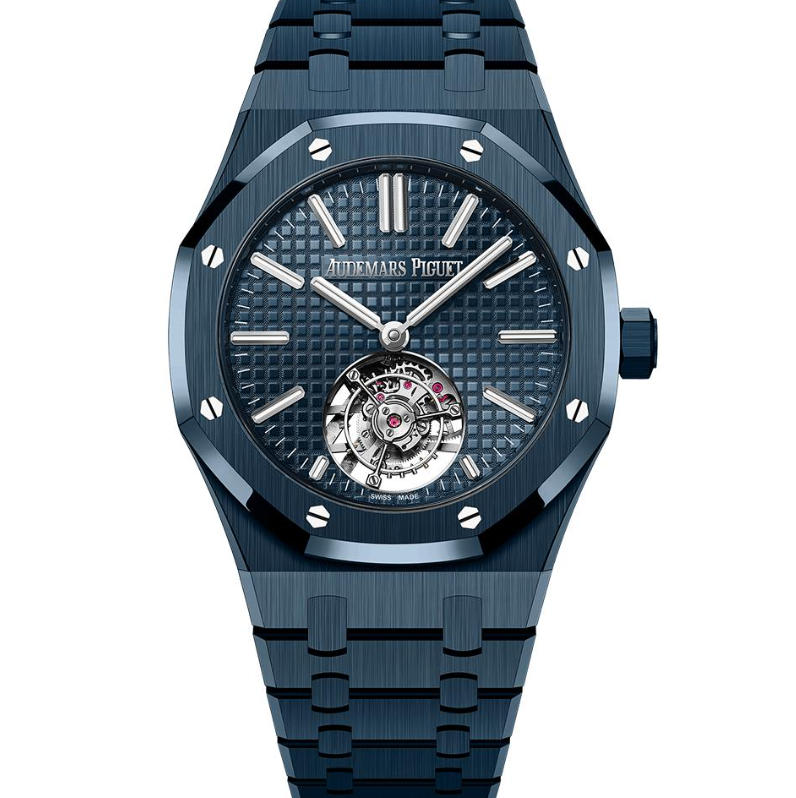
The Royal Oak has appeared in so many metals, colours and complications that a new reference can easily feel like another variation on a familiar formula. The Ref. 26730CD avoids that problem because its most important change is not simply the flying tourbillon. It is the way Audemars Piguet has taken one of the most recognisable colours in Royal Oak history and carried it across almost the entire watch.The case, bezel, crown and integrated bracelet are all made from Bleu Nuit, Nuage 50 ceramic, while the dial continues the same deep blue tone over the familiar Grande Tapisserie pattern. That gives the watch a much more unified appearance than a conventional Royal Oak with a blue dial and contrasting metal case. From a distance it can look almost monochromatic, but closer inspection reveals the brushed surfaces, polished bevels and changing reflections that give the design its depth.For readers following replica watches UK coverage on Pondwatch, this is exactly the sort of model where colour alone tells you very little about accuracy. A replica can reproduce the general blue tone, but the character of this Royal Oak depends on proportion, finishing and the way the ceramic changes under different light.
Blue Ceramic Changes More Than the Colour
The genuine watch measures 41mm across, a familiar size for a modern Royal Oak, but the ceramic changes the way those proportions are perceived. The Royal Oak has always relied heavily on geometry. Its broad octagonal bezel, exposed screws, sharp case edges and integrated bracelet create a surface that reacts to light from several directions at once.That makes the material difficult to execute convincingly. The brushed sections need to remain clean and directional, while the polished bevels must be sharp enough to define the architecture without looking overly glossy. Because both finishes appear in the same dark blue material, weak finishing becomes easier to notice. The Bleu Nuit ceramic Royal Oak depends on surface contrast just as much as colour accuracy.

The colour itself is more complex than it first appears. Under softer indoor light it can look deep navy, while stronger daylight brings out a clearer blue tone. A poor interpretation can look too bright, too purple or too flat, which changes the personality of the whole watch. On this reference, colour is not a decorative layer added to an existing case. It is part of the construction and part of the design language.The dial follows the same restrained approach. Its Grande Tapisserie texture adds depth without introducing another strong colour, while the white gold markers and hands provide enough contrast for easy reading. At 6 o’clock, the flying tourbillon breaks the otherwise controlled blue surface and becomes the natural focal point.

That restraint is important. A busier display would compete with the ceramic case, but the simple arrangement of hours, minutes and flying tourbillon leaves enough space for the material and finishing to carry the design. The watch looks technical without needing to advertise every part of its mechanism on the dial.
The Flying Tourbillon Reveals Where Visual Similarity Ends
Inside the genuine Ref. 26730CD is Audemars Piguet’s self-winding Calibre 2950. The movement combines automatic winding with a flying tourbillon and offers a 65-hour power reserve. The tourbillon appears to float at 6 o’clock because it is supported from below rather than by a conventional upper bridge.This is one of the clearest areas where genuine and replica watches need to be discussed separately. A replica may reproduce the open aperture and visible rotating mechanism, but that does not make it mechanically equivalent to Calibre 2950. The architecture, regulation, finishing and construction of the original movement belong to a different level of watchmaking.
For that reason, a Royal Oak flying tourbillon replica should be judged separately for visual accuracy and mechanical construction. The more useful questions are whether the opening sits in the correct position, whether the dial remains balanced around it, whether the movement forces the case to become too thick and whether the watch still sits naturally on the wrist.Case thickness matters more than many buyers realise. Some replicas can look convincing from directly above but lose the effect from the side because the movement requires a deeper case. On a Royal Oak, that difference is especially noticeable because the case profile and integrated bracelet are such important parts of the design.The caseback tells a similar story. The genuine movement uses traditional finishing and a 22-carat pink gold oscillating weight with a rhodium-toned appearance. Replica movements may copy some visible details, but the depth of the bridges, the quality of the bevels and the overall movement architecture usually reveal much more on closer inspection.

Why This Royal Oak Is a Useful Benchmark for Replica Buyers
This model is particularly interesting from a replica perspective because it combines several difficult elements in one watch. Coloured ceramic, alternating brushed and polished surfaces, an integrated bracelet, a textured monochrome dial and an exposed flying tourbillon all demand accuracy in different ways.None of those details can be judged properly from a single front-facing photograph. The side profile matters. The bracelet taper matters. The articulation between the links matters. The colour under natural light matters. Even the edges of the bezel and bracelet links matter because the Royal Oak design leaves very little room for soft or imprecise finishing.

Readers looking at other versions of the model can browse the Audemars Piguet replica watches and Royal Oak articles on Pondwatch. Comparing steel, black ceramic, openworked and coloured ceramic versions makes it easier to understand how much of the Royal Oak’s identity comes from material and surface treatment rather than the basic outline alone.
For UK replica watch buyers, this model is also a good reminder not to put too much weight on labels such as 1:1 or super clone. Those terms say very little about whether the ceramic tone is convincing, whether the brushing follows the right direction, whether the bracelet feels solid or whether the case remains close to the original proportions. The most convincing Royal Oak replica details are usually found in proportion, finishing and material behaviour rather than marketing language.The genuine Ref. 26730CD works because Audemars Piguet has not treated Bleu Nuit, Nuage 50 as decoration. The colour runs through the identity of the entire watch. The familiar Royal Oak architecture is still clearly visible, but the ceramic gives it a darker, cleaner and more technical character.That also makes this version a difficult benchmark for replica makers. Matching the outline of a Royal Oak is relatively straightforward. Matching the depth of the blue ceramic, the contrast between brushed and polished surfaces, the proportions of the flying tourbillon opening and the feel of the integrated bracelet is where the real comparison begins.
That is why this reference deserves more than a short specification post. It shows how much the Royal Oak depends on material, proportion and finishing, and why a watch that looks simple in photographs can become far more revealing once you start looking at the details that actually define it.